
7 Signs You Need Professional Mold Testing
Table of Contents
- 1. Persistent Musty or Earthy Odors You Can’t Eliminate
- 2. Visible Mold Growth, Discoloration, or Water Stains
- 3. Recent Water Damage, Leaks, or Basement Flooding
- 4. Toxic Mold Exposure Symptoms That Won’t Go Away
- 5. Can Mold Cause Neurological Health Issues?
- 6. Physical Signs of Hidden Moisture in Your Home
- 7. How to Document Mold for Legal Claims and Post-Remediation Verification
- Conclusion: When Professional Mold Testing Is the Right Next Step
- Frequently Asked Questions
Last Updated: September 28, 2026
1. Persistent Musty or Earthy Odors You Can’t Eliminate
A musty smell that keeps coming back isn’t a housekeeping problem. It usually means moisture is feeding a mold colony somewhere you can’t see, and that’s one of the clearest signs you need professional mold testing.
2. Visible Mold Growth, Discoloration, or Water Stains
Visible growth is the sign most people act on, and it’s worth acting on early. Any patch larger than a small area, or any growth that keeps returning after cleaning, deserves testing rather than another round of bleach.
Painting or sealing over a stained wall traps moisture behind the new surface. The mold colony keeps growing, and by the time it shows again the affected area is usually much larger.
3. Recent Water Damage, Leaks, or Basement Flooding
Here’s the part most guides skip: mold doesn’t need a flood. A slow supply-line leak or a single basement flooding event is enough, because growth can begin within a day or two when materials stay wet.
- A burst pipe, roof leak, or appliance overflow
- Standing water that took more than a day to dry
- Repeated condensation on windows, pipes, or exterior walls
- A crawl space that stays damp year-round
4. Toxic Mold Exposure Symptoms That Won’t Go Away
Toxic mold exposure symptoms are the reason many people start searching in the first place. Symptoms that improve when you leave the building and return when you come back are a strong signal that something in the indoor environment is the trigger.
Respiratory and Allergy Symptoms
Ongoing allergen exposure indoors often shows up as a cough that won’t clear, nasal congestion, sneezing, or a scratchy throat that eases on vacation. People with asthma triggers already in their history may notice more frequent flare-ups or a need for their inhaler. The CDC’s guidance on mold and health notes that mold exposure can cause allergic reactions and irritate the eyes, skin, nose, throat, and lungs, and that people with asthma or mold allergies may react more severely. Respiratory distress that worsens at home deserves a medical evaluation and a look at the building itself.
Headaches, Fatigue, and Dizziness
Headaches, fatigue, and dizziness are less specific, which is exactly why they get dismissed. A common mistake is treating these as purely stress-related when they track with time spent in a particular building. Track your symptoms by location and time of day for two weeks. That log becomes useful evidence later.
5. Can Mold Cause Neurological Health Issues?
The short answer: it’s an open question, and honest sources say so. But the reason it stays open is more useful than the verdict, because it explains why testing, not symptom-guessing, is the only way to know what you’re actually breathing.
Not All Mold Is the Same
“Mold” is a category, not a diagnosis. The species that drives most of the concern is Stachybotrys chartarum, often called toxic black mold. It’s a slow-growing, water-loving fungus that colonizes cellulose-rich materials, drywall paper, ceiling tile, wood framing, and the paper facing on insulation, after sustained wetting, not after a brief spill. Common household molds like Cladosporium, Penicillium, and Aspergillus are far more widespread and usually less concerning at low indoor levels.
How Exposure Actually Happens
Two pathways drive the research interest:
- Spore inhalation. Mold releases spores as part of its reproductive cycle, and disturbed colonies, from demolition, HVAC operation, or simply walking past a contaminated wall, aerosolize them. Spores are large enough that many are trapped in the upper airway, but the smallest fragments reach deeper.
- Mycotoxin exposure. Certain species, including Stachybotrys, produce mycotoxins as secondary metabolites. These compounds can be carried on spores and on fine dust. The research question is whether chronic low-level inhalation contributes to symptoms like brain fog, memory trouble, and difficulty concentrating.
What the Research Does and Doesn’t Establish
The EPA’s indoor air quality resources on mold focus on moisture control and exposure reduction rather than diagnosis, which is the right posture, there is no clinically validated blood test or panel that confirms “mold toxicity,” and no exposure threshold that predicts neurological symptoms in a given person. The CDC’s guidance on mold and health similarly frames mold primarily as an allergen and irritant, noting that people with asthma or mold allergies may react more severely.
If neurological symptoms are your main concern, the productive sequence is: (1) get medically evaluated, (2) get the building tested so you have a documented exposure record, and (3) keep both files dated. Speculation about mechanism without a test report leaves you with nothing to act on.
6. Physical Signs of Hidden Moisture in Your Home
Hidden moisture leaves physical evidence before mold becomes visible. These are the building-level clues that justify testing even when you can’t see or smell anything.
- Bubbling, cracking, or peeling paint
- Soft, spongy drywall or sagging ceiling sections
- Warped floorboards or a floor that feels uneven
- Condensation on interior pipes or windows
- A crawl space inspection that turns up damp insulation
- HVAC system contamination: musty air from vents when the system runs
How a Professional Actually Finds What You Can’t See
This is where the gap between a visual walkthrough and real testing opens up. A qualified inspector typically works in three layers:
- Moisture mapping. A pin-type or pinless moisture meter reads the percentage of moisture in drywall, framing, and subfloor. Readings are compared wall-to-wall and against a known-dry reference area. A thermal imaging camera then scans for temperature differentials, evaporating moisture cools a surface slightly, so a hidden wet cavity often shows as a cold patch behind an apparently dry wall.
- Air sampling. A calibrated spore trap pulls a known volume of air (commonly 75 liters over a set interval) onto a slide. The lab counts and identifies spores per cubic meter. The number alone is meaningless, it’s compared against an outdoor control sample collected the same day, because outdoor spore levels swing with season, weather, and time of day.
- Surface sampling. Tape lifts or swabs confirm what’s growing on a specific spot. These identify genus and sometimes species, which air samples can’t always pin down.
Why DIY Kits Often Miss the Problem
DIY kits are cheap and easy, and that’s where the advantages end. A kit like My Mold Detective’s lab-based test kit can produce lab-verified results, but you have to correctly identify where to sample, and a missed location means a missed problem. Kits also can’t measure spore count against an outdoor baseline, can’t perform air sampling or surface swabbing across multiple rooms, and can’t interpret results in context.
If you do use a DIY kit, sample the room where you spend the most time and one outdoor control sample at the same time. Without an outdoor comparison, a lab result tells you mold exists somewhere, which you already suspected.
Testing Is Not Removal
One more distinction worth making explicit: an inspection tells you what’s there and where. It does not remove it. Remediation, containment, HEPA filtration, removal of contaminated materials, and drying, is a separate scope of work, and the two are often performed by different firms for good reason. Mixing them can create a conflict of interest, since the same company that diagnoses the problem also profits from the fix.
7. How to Document Mold for Legal Claims and Post-Remediation Verification
How to document mold for legal claims comes down to one principle: create a dated, independent record before anything is cleaned or removed. Photographs you take yourself are a start, but they carry less weight than a report from a qualified third party.
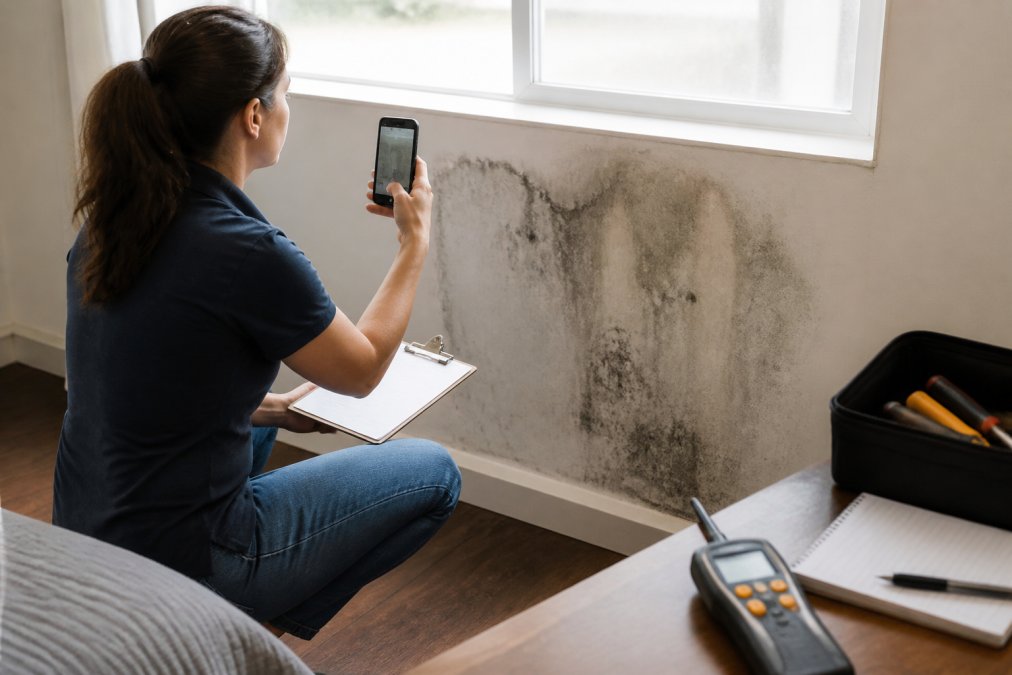
Build your file in this order:
- Photograph and date every area of visible growth or staining
- Keep a written symptom log with dates and locations
- Save all medical records, test results, and receipts
- Report the condition to your landlord or property manager in writing
- Request a professional inspection and keep the full report
- Do not discard damaged materials before they’re documented
- After remediation, arrange clearance testing to verify the work
Conclusion: When Professional Mold Testing Is the Right Next Step
The pattern across all seven signs is the same: a persistent odor, a stain that returns, symptoms that follow you from room to room, or a moisture problem you never fully dried. Each one means the question isn’t whether mold is present, but where it is and how far it’s spread. That question gets answered by testing, not by guessing.
Frequently Asked Questions
What are the 10 warning signs of mold toxicity?
Common warning signs include persistent musty odors, visible mold growth, recent water damage, unexplained respiratory symptoms, worsening asthma, headaches, fatigue, dizziness, skin irritation, and cognitive difficulties like memory problems. If you notice several of these together, professional mold testing can confirm whether mold is present and identify the specific types and spore counts in your home. Documenting these signs early also strengthens any future legal claim.
How does professional mold testing differ from DIY kits?
DIY kits let you collect samples for lab analysis, but you must correctly identify where to sample. Professional testing involves moisture mapping, air sampling, surface swabbing, and HVAC system inspection by certified technicians. Professionals also interpret spore counts against outdoor baseline levels and produce reports suitable for insurance claims or legal documentation. DIY results can miss hidden mold colonies behind drywall or in crawl spaces.
Can mold cause neurological health issues?
Some research links toxic mold exposure to neurological symptoms such as headaches, dizziness, memory difficulties, and confusion. Mycotoxins produced by certain mold species may contribute to these effects, though individual responses vary widely. If you experience neurological symptoms alongside musty odors or visible mold, professional mold testing can identify the species present and document exposure levels. A qualified medical professional should evaluate your symptoms, and an attorney can help assess whether the exposure supports a legal claim.
How do I document mold for a legal claim?
Start by photographing all visible mold, discoloration, and water damage with timestamps. Keep a written log of odors, symptoms, and dates. Save receipts for medical visits, temporary housing, and remediation. Request a professional inspection report that includes air sampling and surface swabbing results. Avoid disturbing mold before it is documented. An attorney experienced in mold toxic tort cases can guide you on preserving evidence and meeting filing deadlines.
What should I do if my home tests positive for toxic mold?
If testing confirms toxic mold, avoid disturbing the affected areas to prevent spore release. Contact a certified remediation company for a written scope of work, and consider post-remediation clearance testing to verify the mold has been properly removed. If you have health symptoms, see a doctor familiar with mold-related illness. For legal options, consult an attorney who handles mold exposure cases and can help you pursue compensation for medical bills and property damage.
Mold cases get lost when the evidence trail is thin. Abkarian Law Group helps you build it from the start, with legal guidance for mold injury claims, connections to functional medical doctors, and a track record of securing substantial settlements. Book a consultation with Abkarian Law Group to protect your health and your legal rights.
