
How to Sue a Landlord for Mold: A Step-by-Step Guide
Table of Contents
- Legal Grounds for a Mold Lawsuit Against Your Landlord
- How to Document Mold in Your Rental Property
- Proving Landlord Negligence and Knowledge
- Understanding Tenant Rights and Mold Exposure
- Statute of Limitations for Mold Lawsuits
- Steps to Take Before Filing a Lawsuit
- Hiring a Mold Lawyer to Build Your Case
- Types of Damages You Can Recover
- Frequently Asked Questions
Last Updated: September 30, 2026
Legal Grounds for a Mold Lawsuit Against Your Landlord
When mold infests your rental property, you have legal options, including the ability to sue landlord mold cases through negligence and breach of contract claims. The foundation of any mold lawsuit rests on proving your landlord failed their duty to maintain habitable housing through the implied warranty of habitability.
Negligence is the primary legal theory in mold cases. You must show: your landlord had a duty to maintain the property, they breached that duty, their breach caused your injury, and you suffered real damages. Mold growth violates this duty because landlords are responsible for addressing water leaks, moisture problems, and structural issues that enable mold to spread.
Breach of contract also applies. Your lease agreement likely contains clauses requiring the landlord to maintain the premises and comply with housing codes. When mold develops due to the landlord’s failure to repair leaks or address moisture, they’ve breached the contract.
The strongest cases combine documented mold growth, medical evidence linking symptoms to exposure, and proof the landlord knew or should have known about the problem.
Document everything from day one. Take photos, save emails, keep receipts for medical visits. This evidence becomes your case foundation.
How to Document Mold in Your Rental Property
Proper documentation transforms a complaint into a case. Photograph and video every visible mold patch, discoloration, or water damage using natural lighting. Include wide shots showing location, then close-ups showing detail and extent.
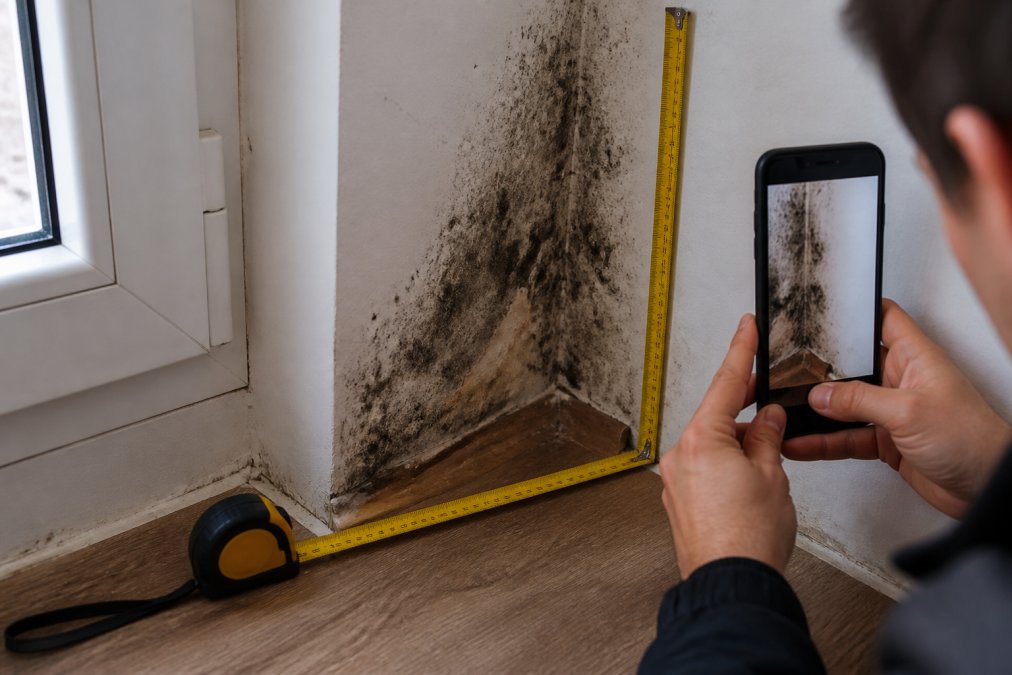
Photography and Video Evidence
Take photos from multiple angles, capturing mold size relative to coins or rulers. Video should show the affected area from entry to close-up with narration. Record date and time, and store files in cloud storage immediately.
Create a written log noting when you first noticed the mold, where it appears, and how it’s spreading. Record date, time, location, and any water leaks or moisture problems. This timeline proves when the problem started and whether the landlord ignored it.
Medical and Health Documentation
Visit your doctor and describe your symptoms clearly. Request that your doctor document the connection between your symptoms and mold exposure in your medical records, noting whether symptoms are consistent with mold sensitivity.
Keep records of all medical visits, prescriptions, and treatments. Medical bills prove damages. If symptoms improve after leaving the property, that pattern strengthens your case.
Don’t diagnose yourself. A doctor’s written observation that your symptoms are consistent with mold exposure carries far more weight than your own assessment. Medical records are critical evidence.
Proving Landlord Negligence and Knowledge
Your case strengthens when you can show the landlord knew about the mold problem. Written notice is your most powerful tool.
Send your landlord a certified letter describing the mold, its location, and discovery date. Keep the certified mail receipt as proof of notification. Landlord non-response strengthens your case by showing willful neglect.
If the mold resulted from a water leak the landlord knew about, that’s powerful evidence. Collect emails, texts, or letters where you reported leaks, water stains, or moisture problems. Complaints from other tenants about the same issue provide additional proof.
Professional mold assessment reports carry significant weight with courts. Expert documentation of mold extent and moisture source usually traces back to landlord negligence.
Understanding Tenant Rights and Mold Exposure
Tenants have fundamental rights regarding habitability. Your rental must be safe and free from hazards. Mold violates these standards. Many jurisdictions allow tenants to withhold rent, repair-and-deduct, or break the lease without penalty when habitability is compromised.
Tenant rights vary by state. Some require landlords to disclose known mold; others mandate specific remediation procedures. Some recognize constructive eviction, allowing you to leave and stop paying rent when conditions become uninhabitable.
Prolonged mold exposure can cause respiratory problems, allergic reactions, neurological symptoms, and immune system damage. These health impacts justify your lawsuit and support damage claims.
Statute of Limitations for Mold Lawsuits
The statute of limitations determines how long you have to file a mold claim. These periods vary significantly by state and claim type, missing the deadline eliminates your right to recover damages.
Discovery Rule vs. Injury Date
Most states use the “discovery rule” for mold cases: the statute of limitations clock starts when you discovered (or reasonably should have discovered) that mold caused your injury, not when you first noticed mold.
Example: You notice mold in January but assume it’s cosmetic. By June, respiratory problems develop and a doctor documents symptoms consistent with mold exposure. Under the discovery rule, your statute of limitations typically begins in June, not January.
Some states use the “injury date rule,” where the clock starts when injury occurred, regardless of discovery. A few apply a “reasonable discovery” standard. These variations make state-specific research essential.
State-Specific Deadlines
Personal injury claims typically range from two to four years; property damage claims often one to three years. Some states distinguish between contract claims (breach of lease) and tort claims (negligence), applying different deadlines.
Some states allow three years for personal injury but two years for property damage. Others extend to four years if the landlord actively concealed the mold. A few toll (pause) the statute if you were a minor when injured, potentially extending your deadline.
The Importance of Acting Quickly
Even with a three or four-year statute of limitations, waiting is strategically dangerous. Memories fade, witnesses become unavailable, evidence deteriorates, and mold can be remediated, making it harder to prove the original extent.
Some states recognize a “statute of repose,” an absolute deadline regardless of discovery. A few impose a 10-year repose period from the mold’s origin, after which no claim can be filed.
Contact a mold lawyer within weeks of discovering the connection between mold and your health symptoms, not months or years later. Your state’s statute of limitations is running, and early action preserves evidence, witness testimony, and your legal rights. A lawyer can immediately determine your specific deadline based on your state’s discovery rule and the type of claim you’re pursuing.
Steps to Take Before Filing a Lawsuit
Before you sue landlord mold through litigation, take strategic steps that strengthen your position and protect your legal rights. Understanding when to file an insurance claim versus when to pursue litigation can save time and money.
Insurance Claim vs. Litigation: Which Path First?
Filing a renter’s insurance claim should often come before suing. Renter’s insurance typically covers personal property damage, medical expenses, and temporary relocation costs. Filing a claim is faster than litigation and can generate compensation within weeks.
Renter’s insurance has limits: most policies cap coverage at $20,000 to $50,000 and may exclude certain mold damage or health claims. Filing an insurance claim does not prevent later suing the landlord.
Pursue litigation when damages exceed insurance limits, your claim is wrongfully denied, you’re seeking damages beyond insurance coverage (pain and suffering or punitive damages), or you want to hold the landlord accountable for negligence.
Understanding Your Duty to Mitigate Damages
The duty to mitigate damages means you must take reasonable steps to reduce mold harm, or courts may reduce your damages award. Landlords will argue failure to mitigate, and courts take this defense seriously.
Sending Written Notice to Your Landlord
Send a formal written notice describing the mold problem, location, discovery date, and health symptoms. Request remediation within 14 to 30 days via certified mail with return receipt.
Obtaining Professional Mold Assessment
Hire a certified mold inspector to assess the property, identify mold types, measure spore levels, and determine moisture sources. This professional report becomes key evidence and supports testimony about remediation standards.
Consider having the mold inspector also conduct air quality testing to measure mold spore levels. While visual inspection is important, quantified spore data provides stronger evidence of the severity of the problem and supports health-related damage claims.
Hiring a Mold Lawyer to Build Your Case
A mold lawyer understands how to connect health symptoms to mold exposure, prove landlord negligence, calculate damages, and manage the litigation process.
Types of Damages You Can Recover
Mold lawsuits can recover multiple types of damages. Understanding what you’re entitled to helps you evaluate settlement offers and understand your case’s value.
Frequently Asked Questions
What steps should I take to document mold before filing a lawsuit?
Document mold with dated photographs and videos showing the extent of growth and affected areas. Collect medical records linking your symptoms to mold exposure. Send written notice to your landlord via certified mail describing the problem and requesting remediation. Keep copies of all communications. If possible, obtain a professional mold assessment from an environmental testing company. Preserve physical samples if safe to do so. This evidence forms the foundation of your case when you sue a landlord for mold infestation.
How long do I have to file a mold lawsuit against my landlord?
The statute of limitations for mold lawsuits varies by state. Most states allow two to four years from the date you discovered or should have discovered the mold damage. Some states apply a separate deadline for personal injury claims related to mold exposure. Your location and the specific nature of your claim determine the exact deadline. Contact a mold lawyer immediately to confirm the statute of limitations in your jurisdiction and avoid losing your right to sue.
What are my rights as a tenant when exposed to mold?
Tenant rights regarding mold exposure are governed by the implied warranty of habitability, which requires landlords to maintain rental properties in a safe, livable condition. You have the right to request mold remediation in writing. Many states allow tenants to withhold rent, repair-and-deduct (paying for repairs yourself and deducting costs from rent), or break the lease without penalty if a landlord fails to address serious mold problems. Document all communication with your landlord and consult a lawyer to understand your specific rights under state and local law.
How do I know if I need to hire a mold lawyer?
Hire a mold lawyer if you’ve suffered significant health effects from mold exposure, your landlord refuses to remediate the problem, or you’ve incurred substantial medical bills and lost income. A mold lawyer can evaluate whether your case has merit, determine the damages you can recover, and handle negotiations or litigation. Many mold lawyers work on contingency, meaning you pay nothing upfront and fees come from your settlement or judgment. A consultation with a mold lawyer helps clarify your legal options without financial risk.
