
Proving Negligence in Mold Exposure Lawsuits
Table of Contents
- The Four Elements of Negligence in Mold Cases
- Landlord Liability for Mold: Legal Standards and Obligations
- Documenting Mold Damage for Legal Claims
- Establishing Causation Between Mold Exposure and Illness
- Hiring a Mold Expert Witness
- Statute of Limitations for Mold Lawsuits
- Mitigation and Your Legal Responsibility as a Tenant
- Moving Forward With Your Mold Exposure Claim
- Frequently Asked Questions
Last Updated: October 1, 2026
The Four Elements of Negligence in Mold Cases
Proving negligence in mold exposure lawsuits requires establishing four distinct legal elements. Your case depends on demonstrating all four. Without even one, your claim will likely fail.
Negligence is the legal foundation for most mold injury cases. It requires proof that someone owed you a duty of care, breached that duty, caused your injury, and you suffered damages as a result.
Think of these four elements as a chain. Break one link, and the entire case collapses.
Duty of Care and Breach
A property owner or landlord has a duty of care to maintain their building in a safe, habitable condition. This isn’t optional, it’s a legal obligation. Landlords must keep properties free from hazards that could harm tenants or occupants.
The duty exists because property owners control the building. They have the power to inspect, repair, and prevent problems. Tenants and visitors do not.
Breach of duty happens when the property owner fails to maintain the space properly. Common breaches include:
- Ignoring water leaks or moisture problems
- Failing to fix plumbing issues that create dampness
- Not addressing visible mold growth
- Refusing repairs after receiving written notice
- Skipping routine maintenance that would prevent mold
Documentation is critical here. Written notice to your landlord, especially through email or certified mail, establishes that they knew about the problem and did nothing.
Causation and Damages
Causation means proving the mold directly caused your illness. This is where many cases struggle. You must show a clear link between your exposure and your health problems.
Damages are the injuries you suffered. These include medical bills, lost wages, pain and suffering, and ongoing treatment costs. Without measurable damages, you have no case worth pursuing.
Landlord Liability for Mold: Legal Standards and Obligations
Landlord liability for mold hinges on the concept of habitability. Most states recognize an implied warranty of habitability, meaning rental properties must be fit for human occupancy.
Mold violations this warranty. A unit with active mold growth is not habitable, even if the rent is paid and the lease is signed.
Landlords cannot escape this obligation through lease language. You cannot waive your right to a safe, mold-free home. Courts will not enforce clauses that attempt to do so.
The landlord’s liability depends on whether they:
- Knew about the mold (actual knowledge or should have known)
- Had reasonable time to fix it after notice
- Failed to take corrective action
- The mold resulted from their negligence, not tenant behavior
Landlord liability cases succeed when documentation is thorough and the timeline is clear.
Documenting Mold Damage for Legal Claims
Documentation transforms a “he said, she said” dispute into a compelling legal case. Without it, your claim is weak.
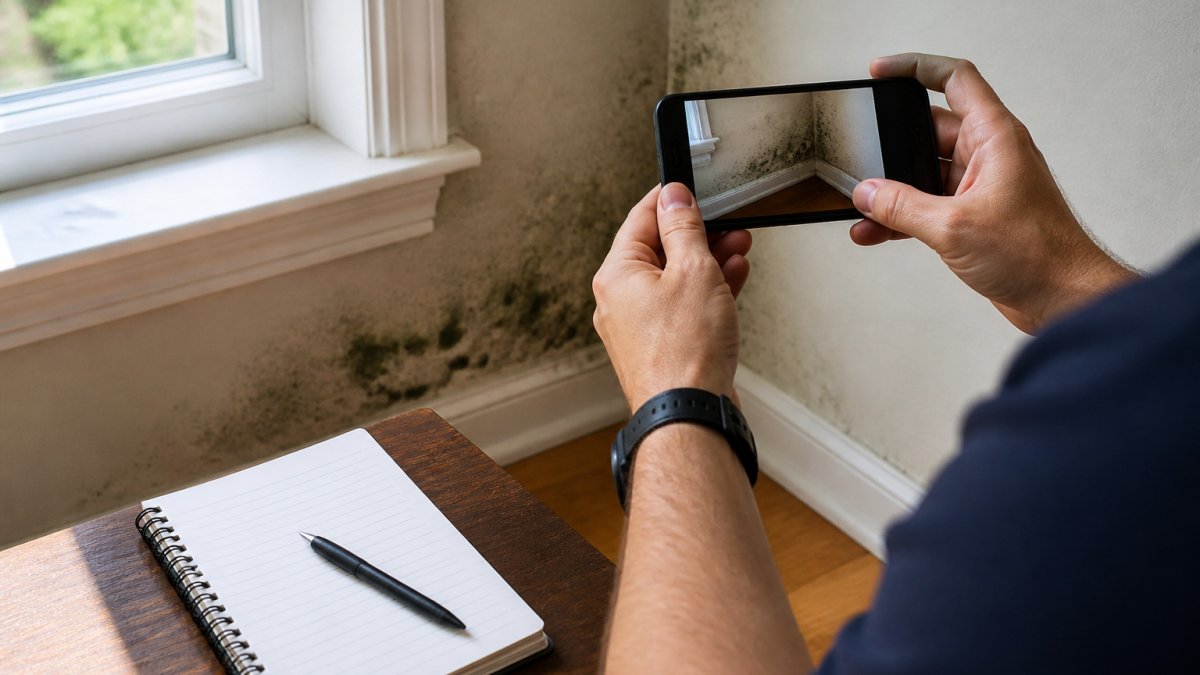
Start documenting immediately. Take photographs and videos of visible mold. Capture the extent, location, and any water damage nearby. Use your smartphone, quality matters less than having a clear record.
Written Notice and Property Condition Records
Written notice is your legal anchor. Sending a formal notice to your landlord creates a documented record that they knew about the problem.
Use email or certified mail. Text messages and phone calls don’t create the same legal weight. Include:
- Specific location of the mold
- Date you first noticed it
- Photos attached to the email
- Request for repair within a reasonable timeframe
- Copies saved for your records
Keep every response, or lack of response.
Maintain property condition records. Document:
- Dates of water leaks or moisture issues
- Photos of damage progression
- Repair requests and responses
- Landlord’s refusal or delay in fixing problems
- Any communication about mold
This timeline becomes critical evidence later.
Professional Testing and Environmental Reports
Professional mold testing provides objective, scientific evidence. A qualified inspector can measure spore counts, identify mold species, and assess air quality.
Environmental reports carry significant weight in court. They show:
- Mold presence confirmed by lab analysis
- Spore counts above normal levels
- Whether mold is in living areas or hidden spaces
- Air quality problems linked to mold
Digital Evidence Preservation
Preserve all digital communications. Screenshots of text messages, emails, and photos are admissible in court if properly authenticated.
Create a backup system:
- Save emails to a folder labeled “Mold Case”
- Screenshot text messages with dates visible
- Store photos in a cloud backup (Google Drive, Dropbox)
- Keep a written log with dates and descriptions
- Never delete anything, even if it seems unhelpful
Establishing Causation Between Mold Exposure and Illness
This is the hardest element to prove. Causation requires medical evidence linking your specific health problems to mold exposure.
Medical Evaluation and Health Records
Get a thorough medical evaluation from a doctor who understands mold-related illness. Request:
- Complete medical history documenting when symptoms started
- Tests for mold allergies or sensitivities
- Lung function tests if respiratory issues are present
- Documentation of how symptoms improved after leaving the moldy environment
- Records showing symptoms worsened when returning to the property
Medical records should show:
- Dates of symptom onset
- Specific symptoms documented at each visit
- Doctor’s assessment linking symptoms to mold exposure
- Treatment prescribed and how it affected symptoms
- Any hospitalization or emergency care
These records become the foundation of your causation argument.
Functional medicine doctors often have more experience recognizing mold-related illness than general practitioners. They tend to take a comprehensive approach to environmental toxins and their health effects. Abkarian Law Group can connect you with medical professionals who understand toxic mold exposure and can provide the detailed documentation needed for your case.
Toxic Versus Non-Toxic Mold: Evidentiary Standards
Not all mold is equally harmful. Courts recognize a distinction between common mold and toxic mold (particularly mold species that produce mycotoxins).
- Neurological symptoms (memory problems, difficulty concentrating)
- Respiratory illness (persistent cough, shortness of breath)
- Immune system suppression
- Chronic fatigue
Proving toxic mold exposure requires:
- Lab analysis identifying the specific mold species
- Spore count testing showing elevated levels
- Medical evidence of symptoms consistent with mycotoxin exposure
- Expert testimony about the health effects of that specific mold
Hiring a Mold Expert Witness
An expert witness can make or break your case. They testify about technical matters that a jury cannot understand without guidance.
A mold expert witness should have:
-
Credentials in environmental science, mycology, or industrial hygiene
-
Experience with mold testing and remediation
-
Published research or professional certifications
-
Prior testimony in mold cases
-
No financial stake in the outcome (independent, not paid by your landlord)
-
How mold grew in the space
-
Why the landlord’s negligence allowed it to spread
-
Health risks from that specific mold exposure
-
What remediation should have occurred
Statute of Limitations for Mold Lawsuits
Time limits exist for filing mold lawsuits. The statute of limitations varies by state and by the type of claim.
Mitigation and Your Legal Responsibility as a Tenant
Tenants have responsibilities too. You cannot ignore a mold problem and expect to win a case.
- Report mold to your landlord in writing immediately
- Request repairs in a timely manner
- Cooperate with inspections and testing
- Leave the property if it becomes uninhabitable (you cannot stay and claim damages for ongoing exposure)
- Seek medical treatment for health problems
Moving Forward With Your Mold Exposure Claim
Proving negligence in mold exposure lawsuits requires patience, documentation, and expert guidance. Each element must be established with evidence.
The process involves:
- Gathering written notice and property records
- Obtaining professional mold testing and environmental reports
- Collecting medical records and expert medical testimony
- Hiring mold and health experts to explain causation
- Documenting your damages (medical bills, lost wages, treatment costs)
Understanding landlord responsibilities for habitability
Guide to mold testing and environmental assessment
Statute of limitations for personal injury claims by state
Frequently Asked Questions
What evidence is required to prove negligence in a mold exposure case?
You must establish four elements: the defendant’s duty of care, breach of that duty, causation between the breach and your illness, and measurable damages. This requires documentation of mold presence through professional testing, written notice to the property owner, medical records linking your symptoms to mold exposure, and expert testimony. Environmental reports showing spore counts and air quality testing strengthen your claim. Digital evidence like photos, emails, and repair records also support your position.
How do you establish a causal link between mold exposure and health issues?
Causation requires medical evaluation from a qualified physician who can connect your symptoms to mold exposure. Your medical records must document the timeline of your illness relative to when you occupied the moldy property. Environmental testing showing elevated spore counts in the space where you spent time is critical. Expert witnesses, including toxicologists or occupational health specialists, testify about how mold exposure causes respiratory, neurological, or immune system damage. The stronger your medical documentation and the more specific the environmental evidence, the clearer the causal link.
What is the statute of limitations for filing a mold-related personal injury lawsuit?
The statute of limitations varies by state and typically ranges from one to six years from the date of discovery of the injury or the negligent act. Some states use a ‘discovery rule,’ meaning the clock starts when you knew or should have known the mold caused your illness, not when you were first exposed. This is why documenting when symptoms began and when you first reported the mold is essential. Consult with an attorney in your state to determine the exact deadline for your claim, as waiting too long can permanently bar your case.
Does a landlord’s failure to remediate mold constitute negligence?
Yes, if you provided written notice of mold or water damage and the landlord failed to address it within a reasonable timeframe, this typically constitutes breach of the duty of care. Landlords have a legal obligation to maintain habitable premises, which includes controlling moisture and preventing mold growth. However, you must prove the landlord knew or should have known about the problem and had a reasonable opportunity to fix it. If you never reported the mold, establishing negligence becomes more difficult, though a landlord may still be liable if the mold resulted from their failure to maintain the property properly.
