
Tenant Rights and Toxic Mold Exposure: A Legal Guide
Table of Contents
- Understanding Tenant Rights and Toxic Mold Exposure
- Landlord Responsibility for Mold Remediation
- How to Report Mold to Your Landlord
- Documenting Mold in an Apartment: Evidence That Matters
- Mold Exposure Symptoms and Health Documentation
- When to Contact Housing Authorities and Your Legal Options
- Tenant Remedies When Landlords Fail to Act
- Protection Against Retaliation and Next Steps
- Frequently Asked Questions
Last Updated: October 10, 2026
Understanding Tenant Rights and Toxic Mold Exposure
Tenant rights toxic mold exposure protects renters from living in unsafe conditions caused by mold contamination. When a landlord fails to address mold problems, tenants have legal remedies available. At Abkarian Law Group, we help renters understand their rights and take action to protect their health and secure compensation.
Mold grows in damp environments and releases spores that cause serious health problems. Your landlord has a legal duty to maintain the property in habitable condition, including preventing and addressing mold.
Many tenants don’t realize that tenant rights toxic mold issues allow them to report mold, document it, request repairs, and pursue legal action if their landlord refuses to act.
Start documenting mold problems immediately. Take photos, save communications with your landlord, and keep medical records. This evidence becomes essential if you need to pursue legal action later.
Landlord Responsibility for Mold Remediation
Your landlord is legally responsible for maintaining habitable living conditions under the warranty of habitability, a legal standard in all U.S. states that requires landlords to keep rental properties safe and livable.
Mold is considered a serious habitability issue because it creates unsafe living conditions. When mold is present, your landlord must:
- Identify the source of moisture causing the mold
- Stop the water intrusion or leak
- Remove the mold through proper remediation
- Restore the affected area to safe condition
Your landlord cannot simply paint over mold or ignore complaints. They must address the root cause. If moisture from a roof leak, plumbing problem, or poor ventilation creates mold, the landlord must fix that problem first.
Most jurisdictions require landlords to act within 14 to 30 days for serious habitability issues; check your state’s specific laws for exact deadlines.
Your landlord cannot ignore mold problems. They must fix the moisture source and remove the mold completely. Failure to do so violates the warranty of habitability and gives you legal grounds to take action.
How to Report Mold to Your Landlord
Written notice creates a legal record and triggers your landlord’s statutory duty to respond. Understanding your state’s specific requirements is critical.
Why written notice matters:
Oral complaints leave no proof. Written notice creates a dated record that courts and housing authorities recognize as valid notification and starts the clock on repair deadlines.
State-specific notice requirements:
Notice rules vary by jurisdiction. Before sending notice, check your state’s tenant-landlord statute, review your lease, and contact your local housing authority to confirm whether your state requires certified mail, email, or hand delivery.
Steps to report mold:
-
Choose your delivery method. Use certified mail with return receipt requested (safest option and accepted in all states).
-
Write a formal notice. Use a formal letter or email that clearly states the problem and your request for action.
-
Be specific. Include your name, address, unit number, date you first noticed the mold, exact location, description of the mold, any water damage or leaks, photos, and a request for inspection within 14-30 days.
-
Set a deadline. Request that your landlord inspect within 14 days and begin repairs within 30 days.
-
Keep copies. Save the original notice, proof of delivery, and any response from your landlord.
Your landlord is now legally on notice. Failure to respond or repair within the required timeframe gives you grounds to file a complaint with housing authorities, pursue rent withholding or repair-and-deduct remedies, break your lease, or sue for damages.
Written notice is your legal foundation. Use certified mail or email with read receipt, be specific about the location and nature of the mold, set a clear deadline, and keep all documentation. Your state’s tenant-landlord law defines what counts as valid notice, verify your jurisdiction’s rules before sending.
Documenting Mold in an Apartment: Evidence That Matters
Documentation is your strongest tool. Photos, written records, and medical evidence prove the mold existed and caused harm.
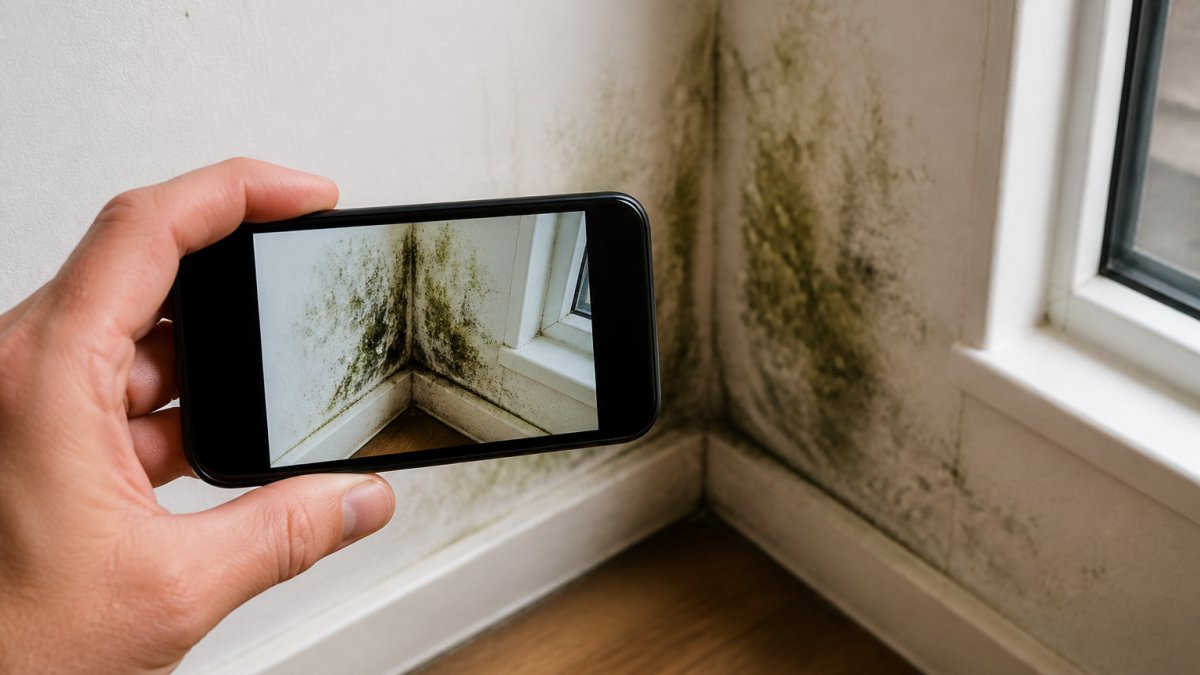
Photograph the mold: Take clear photos from multiple angles with date stamps. Include a ruler for scale and capture water stains or moisture.
Keep written records: Document when you first noticed the mold, all communications with your landlord, repair requests, and health symptoms.
Collect medical evidence: Visit a doctor, request medical records linking symptoms to mold exposure, and keep receipts for medical visits and medications. This evidence is critical for complaints or legal action.
Mold Exposure Symptoms and Health Documentation
Mold exposure causes respiratory issues, allergic reactions, and neurological effects that can appear quickly or develop over weeks.
Respiratory symptoms: Coughing, wheezing, shortness of breath, chest tightness, and asthma attacks.
Allergic reactions: Sneezing, nasal congestion, itchy eyes, skin rashes, and sinus infections.
Other effects: Headaches, fatigue, joint and muscle pain, and neurological symptoms in severe cases.
People with asthma, allergies, or weakened immune systems face higher risk. If you develop symptoms, see a doctor and request documentation linking your symptoms to mold exposure.
Do not ignore persistent symptoms. Mold exposure can cause serious long-term health problems. Medical documentation protects your health and strengthens your legal case if you need to pursue damages.
When to Contact Housing Authorities and Your Legal Options
If your landlord ignores your complaint, contact your city or county health department or housing authority. Provide your documentation, photos, complaint letters, and medical records. Housing inspectors can document the mold, issue violations, order repairs, and impose fines. The inspection process typically takes 1-2 weeks.
Your legal options include rent withholding, repair-and-deduct, lease termination, and damages claims. Abkarian Law Group specializes in helping tenants pursue mold exposure claims and secure settlements covering medical costs and losses.
Tenant Remedies When Landlords Fail to Act
The escalation sequence:
- File a complaint with housing authorities (low risk, no cost)
- Pursue rent withholding (medium risk, state-dependent)
- Attempt repair and deduct (medium risk, state-dependent)
- Terminate the lease (high risk if done improperly)
- Sue for damages (highest complexity, requires legal representation)
Not all remedies are available in every state. Before pursuing any remedy, verify that your state law permits it.
Remedy 1: Housing authority complaint (no cost, low risk)
Filing a complaint with your local housing authority or health department is the safest first step.
Advantages: No cost, no legal risk, creates an official record.
Disadvantages: Does not directly compensate you; relies on government enforcement.
Remedy 2: Rent reduction or withholding (medium risk, state-dependent)
Many states allow tenants to withhold rent when the unit becomes uninhabitable due to mold.
Advantages: Pressures your landlord to repair.
Remedy 3: Repair and deduct (medium risk, state-dependent)
Some states allow tenants to hire a contractor to fix mold and deduct costs from rent.
Advantages: You control the repair process.
Disadvantages: Requires upfront payment; large deductions may trigger eviction; mold remediation is often expensive.
Remedy 4: Lease termination (high risk if done improperly)
If mold makes the unit uninhabitable, you may break your lease without penalty.
Advantages: You can leave without penalty; you may recover your security deposit.
Disadvantages: High risk if the court disagrees; your landlord may sue; moving is costly and disruptive.
Remedy 5: Lawsuit for damages (highest complexity, requires legal representation)
You can sue your landlord for damages caused by mold exposure.
Damages you can recover:
- Medical expenses: Doctor visits, testing, medications, therapy
- Lost wages: Time missed at work due to illness
- Temporary housing: Costs of relocation during remediation
- Property damage: Belongings damaged by mold or remediation
- Pain and suffering: Compensation for illness, discomfort, and emotional distress
- Punitive damages: In cases of gross negligence or intentional misconduct (rare)
What you must prove:
- The landlord knew or should have known about the mold
- The landlord failed to repair it within a reasonable timeframe
- The mold caused your health problems (medical documentation required)
- You suffered measurable damages (receipts, medical records, lost wage documentation)
Challenges:
- Proving causation is difficult; mold exposure alone may not prove that it caused your specific illness
- Your landlord may argue that you caused the mold (e.g., by not reporting water leaks promptly)
- Litigation is expensive and time-consuming; you may need an attorney
- Some states cap damages in landlord-tenant disputes
Advantages: Potential for significant compensation; creates legal accountability for the landlord.
Disadvantages: Requires legal representation; expensive; time-consuming; burden of proof is on you; outcome is uncertain.
Choosing your remedy:
Start with a housing authority complaint, it is free, low-risk, and creates an official record.
Your remedies escalate from low-risk (housing authority complaint) to high-risk (lawsuit). Each remedy has different legal requirements and state-law variations. Verify your state’s specific rules before pursuing any remedy, and consider consulting an attorney if you plan to withhold rent, repair-and-deduct, or sue.
Protection Against Retaliation and Next Steps
Landlords cannot retaliate against tenants for reporting mold or asserting their rights. Retaliation is illegal in all U.S. states.
Protected activities:
- Reporting mold to your landlord in writing
- Filing a complaint with housing authorities
- Requesting repairs in writing
- Documenting the mold problem
- Pursuing legal action
Illegal retaliation includes:
- Eviction within a set period (typically 30-90 days) after you report the problem
- Rent increases as punishment
- Threats or harassment
- Lease termination without cause
- Reduction of services or utilities
If your landlord retaliates, you have additional legal claims. Document all retaliation, dates, communications, and actions. Report it to housing authorities and your attorney.
Your next steps:
- Document everything, Photos, letters, medical records, communications
- Report in writing, Use certified mail for your complaint
- Follow up, If no response, contact housing authorities
- Seek legal advice, A lawyer can evaluate your case and options
- Pursue damages, File a complaint or lawsuit if necessary
Abkarian Law Group helps tenants navigate this process. We handle the legal work while you focus on your health recovery. Our team connects you with functional medical professionals who understand mold-related illnesses and can document your condition for legal proceedings.
Mold exposure in your rental unit is serious. Your health matters, and your rights are protected by law. If your landlord ignores mold problems, you don’t have to suffer in silence. Abkarian Law Group has helped numerous tenants secure settlements that cover medical bills, lost wages, and pain and suffering. Our team combines aggressive legal advocacy with connections to medical professionals who understand toxic mold exposure. Book a Consultation today to discuss your case and learn what you may be entitled to recover.
Frequently Asked Questions
What are the first signs of mold exposure symptoms I should watch for?
Early mold exposure symptoms often include respiratory issues such as coughing, wheezing, and shortness of breath. Many people also experience allergic reactions like sneezing, nasal congestion, and itchy eyes. Some individuals develop skin irritation or notice neurological effects such as difficulty concentrating or memory problems. If you live in a property with visible mold or water damage and experience these symptoms, document them and seek medical evaluation. Keep records of when symptoms began and any correlation with time spent in the affected space.
Can I sue my landlord for toxic mold exposure and related health problems?
Yes, tenants can pursue legal action against landlords for toxic mold exposure if the landlord failed to maintain the property in a habitable condition or neglected to remediate known mold problems. Your claim may include damages for medical expenses, lost wages, pain and suffering, and relocation costs. Success depends on proving the landlord knew or should have known about the mold, failed to address it within a reasonable timeframe, and that your health injuries resulted from that exposure. An attorney experienced in mold liability cases can evaluate your specific situation and advise you on the strength of your claim.
What should I do immediately after discovering mold in my rental apartment?
First, take photographs and video of all visible mold, water stains, and moisture sources from multiple angles, noting the date. Do not attempt to clean or disturb the mold. Send a written notice to your landlord or property manager via certified mail or email with read receipt, clearly describing the location, extent, and any health symptoms you or household members are experiencing. Keep copies of all correspondence. Avoid spending extended time in heavily affected areas if possible. Document any health changes and seek medical evaluation. Do not withhold rent or vacate without legal guidance, as improper action could weaken your position.
What counts as proper documentation of mold in an apartment for a legal claim?
Strong documentation includes dated photographs and videos showing visible mold growth, water damage, moisture, and affected areas from multiple angles. Keep written records of all complaints you made to your landlord, including dates, method of communication (email, certified letter), and responses received. Collect medical records linking your symptoms to mold exposure, including doctor visits, test results, and treatment records. Maintain receipts for medical expenses and documentation of lost income or relocation costs. Professional mold inspection reports and air quality testing results significantly strengthen your case. Store all evidence in a secure location and provide copies to your attorney.
