
How to Read a Professional Mold Lab Report
Table of Contents
- Understanding Your Mold Lab Report Structure
- Decoding Spore Counts and Concentration Units
- How to Interpret Mold Air Sampling Results
- Reading a Mold Inspection Report Example
- What Is a Bad Mold Score and Elevated Levels
- What to Do After Positive Mold Test Results
- Using Your Mold Lab Report in a Legal Case
- Frequently Asked Questions
Last Updated: October 10, 2026
Understanding Your Mold Lab Report Structure
A mold lab report is a detailed document that shows what mold species were found in your home or workplace and at what levels.
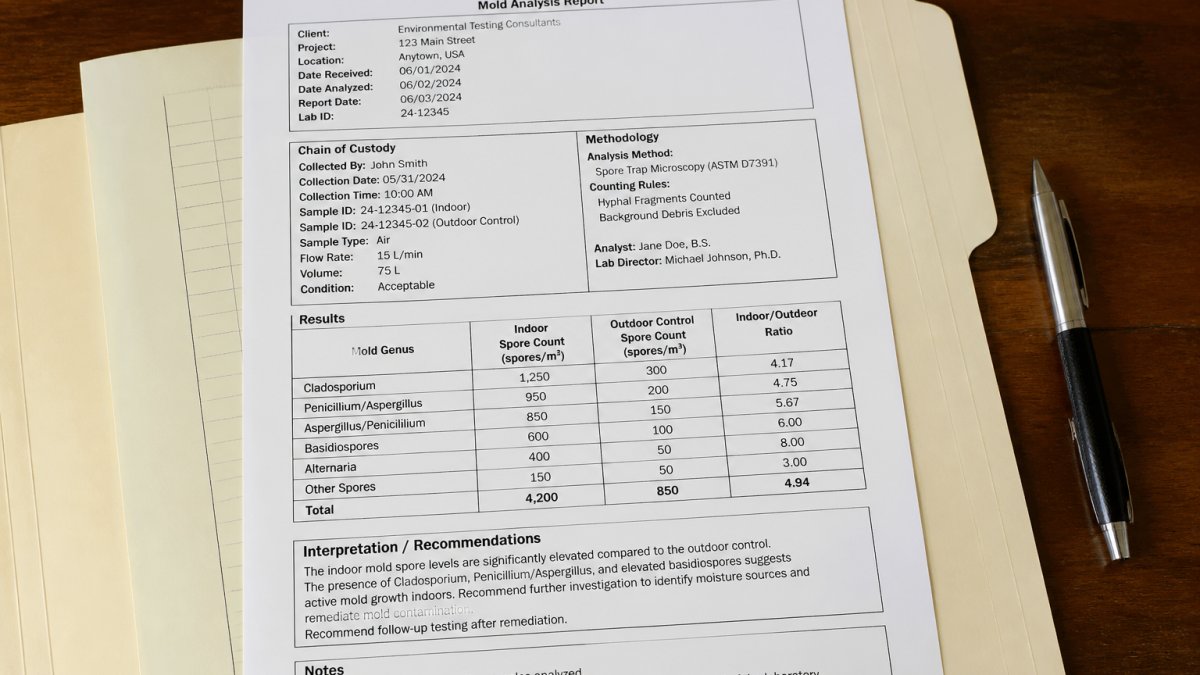
Every professional mold lab report follows a standard format, though the exact layout varies by laboratory. A complete report typically includes:
Header and Sample Identification
The top of the report displays your name, the property address, the date samples were collected, and a unique sample ID number. This section also shows the laboratory’s name, accreditation status, and contact information. Verify the address matches your property and the collection date is recent, reports older than a few weeks may not reflect current conditions if moisture sources remain active.
Chain of Custody Documentation
This section documents who collected the sample, the exact time and date of collection, and every person who handled the sample through analysis.
Results Section
The core of your report lists:
- Mold genera and species identified (e.g., Aspergillus fumigatus, Penicillium chrysogenum)
- Raw spore counts (total spores detected under microscopy)
- Colony-forming units (CFU) (viable spores capable of growth)
- Concentration units (spores per cubic meter for air samples, or spores per square centimeter for surface samples)
- Relative abundance (percentage of total spores each mold type represents)
Results are often presented in a table with columns for each mold genus, its count, and its percentage of the total.
Comparison to Outdoor Control
Your report should include an outdoor control sample collected on the same day as indoor samples. This shows baseline mold levels in outside air.
Recommendations
The report concludes with the laboratory’s interpretation and recommended next steps. This may suggest moisture investigation, professional remediation, or follow-up testing.
Laboratory accreditation and report validity
Laboratory accreditation is your first indicator of report reliability. Look for certifications from recognized bodies such as the American Industrial Hygiene Conference & Exposition (AIHCE), the Proficiency Analytical Testing (PAT) program, or state-level environmental laboratory accreditation.
When evaluating accreditation, check whether it covers the specific test method used on your samples. A lab may be accredited for air sampling but not surface sampling, or vice versa.
Report validity also depends on whether sampling conditions were appropriate. Samples collected during or immediately after rain, or when windows and doors were sealed for an unusually long period, may not reflect typical indoor conditions. The report should note any unusual conditions that may have affected results.
Decoding Spore Counts and Concentration Units
Spore counts tell you how many mold spores were detected in your sample. But the number alone doesn’t mean much without understanding the units and what they represent.
What spores per cubic meter means
Spores per cubic meter is a standard unit for air sampling results. It measures mold spore concentration in the air you breathe. A cubic meter is roughly the size of a large refrigerator. The count shows how many spores occupied that space during testing.
Air sampling captures what you’re actually inhaling. If your indoor spore count is significantly higher than your outdoor control, mold growth is likely happening inside. This comparison is how you determine whether levels are concerning.
Raw counts versus colony-forming units
Raw counts show the total number of spores detected under a microscope. Colony-forming units measure spores that are actually capable of growing into mold colonies. These numbers often differ because not every spore detected can produce new growth.
Laboratory analysis uses both measurements. Raw counts give the full picture of spore presence. Colony-forming units indicate which spores pose an active growth risk. Understanding the difference helps you interpret what the numbers actually mean for your situation.
How to Interpret Mold Air Sampling Results
Air sampling captures mold spores floating in the air. This is the most direct way to measure what you’re breathing. The results show concentration levels and mold types present.
Indoor versus outdoor control comparisons
Your indoor sample should be compared directly to an outdoor control sample collected on the same day. Outdoor air naturally contains mold spores. Your home’s indoor levels should be lower than or similar to outdoor levels.
When indoor counts exceed outdoor counts, mold growth is happening inside your building. The greater the difference, the more significant the indoor problem. This comparison is the foundation for determining whether you have a genuine mold issue.
Detection limits and what they signal
Detection limits are the lowest concentration a laboratory can reliably measure. Results below the detection limit mean mold may be present but in amounts too small to measure accurately. This doesn’t mean the air is clean, it means the level is below the testing threshold.
Understanding detection limits prevents misinterpretation of results. A report stating “below detection limit” doesn’t prove absence. It indicates the sample contained mold at levels the laboratory couldn’t quantify with their equipment and methods.
Reading a Mold Inspection Report Example
A complete mold inspection report walks you through every finding step by step. Each section builds a picture of what mold is present and where.
Surface sampling versus air sampling in practice
Surface sampling collects mold from walls, ceilings, or materials. It shows mold growth in specific locations. Air sampling measures spores floating throughout a space. Both methods are valuable and often used together.
Surface samples identify active mold colonies. Air samples show whether those colonies are releasing spores into the air you breathe. A report combining both methods gives the clearest understanding of your mold situation.
Mold genera and species identification
The report identifies mold by genus, like Aspergillus, Penicillium, or Stachybotrys. Species identification goes further, naming the exact type. Common indoor molds include Aspergillus fumigatus and Penicillium chrysogenum.
Not all molds are equally concerning. Some species are more likely to cause health effects. The identification section helps you understand whether the mold found poses elevated health risks. This information becomes crucial if you’re pursuing a legal claim for mold-related illness.
What Is a Bad Mold Score and Elevated Levels
Elevated mold counts mean levels higher than what’s typical for that environment. A “bad” result indicates mold growth serious enough to warrant action.
MoldSCORE and relative abundance explained
MoldSCORE is a scoring system some laboratories use to categorize results. It compares your indoor findings to outdoor baselines and assigns a rating. Relative abundance shows what percentage of total spores each mold type represents.
A high percentage of a single mold type can indicate active growth of that species. When one genus dominates your sample, it suggests that mold is thriving in your space. This pattern is more concerning than a diverse mix of common outdoor molds.
When results warrant immediate action
Results warrant immediate action when indoor counts significantly exceed outdoor controls. Visible mold growth combined with elevated air samples indicates an active problem. Health symptoms combined with elevated mold findings suggest exposure is affecting you.
If you’re experiencing respiratory or neurological symptoms and mold testing shows elevated levels, medical evaluation becomes urgent. Documenting the connection between test results and health effects strengthens any legal claim you might pursue.
| Finding Type | What It Means | Recommended Action |
|---|---|---|
| Indoor exceeds outdoor by 2-3x | Possible active growth | Investigate moisture sources |
| Single mold genus dominates | Active growth of that species | Professional remediation likely needed |
| Below detection limit | Mold present but unmeasurable | Reassess after remediation |
| High colony-forming units | Viable spores capable of growth | Address moisture immediately |
What to Do After Positive Mold Test Results
Positive mold test results require a structured response. Your first step is understanding what the results actually show.
Steps for moisture investigation and remediation
Begin by identifying moisture sources. Mold cannot grow without moisture. Finding and eliminating the water source stops mold growth at its root. Common sources include roof leaks, plumbing failures, or poor ventilation.
Professional mold remediation follows moisture control. Remediation companies remove contaminated materials and clean affected areas. They use specialized equipment and techniques to prevent spore spread during cleanup. After remediation, follow-up testing confirms success.
When follow-up testing is necessary
Follow-up testing validates that remediation worked. Testing typically occurs 24-48 hours after cleanup finishes. Results should show indoor counts returning to outdoor baseline levels. If elevated levels persist, additional remediation is needed.
Using Your Mold Lab Report in a Legal Case
Mold lab reports become legal evidence when you’re pursuing a toxic exposure claim. The documentation must meet specific standards for courtroom use.
How lab findings support toxic exposure claims
Lab results establish that mold exposure actually occurred. They document elevated indoor levels and identify specific mold species present. Combined with medical evidence linking mold exposure to your health decline, lab findings create a compelling case.
According to research on mold-related illness documentation, establishing the connection between environmental exposure and health effects requires both testing data and medical records. Your mold lab report provides the environmental evidence. Medical records from a functional medicine professional establish the health impact.
Documentation requirements for settlements
Insurance companies and defendants require proper documentation for settlement negotiations. Your mold lab report must show proper chain of custody. The laboratory performing testing should be accredited. Results must clearly demonstrate elevated indoor mold levels.
Medical records linking your symptoms to mold exposure strengthen settlement negotiations significantly. At Abkarian Law Group, we connect clients with functional medical professionals who understand mold-related illness.
Complete documentation, including the mold lab report, moisture investigation findings, remediation records, and medical evidence, creates the strongest legal position. guidance on toxic tort documentation standards emphasizes that thorough evidence collection is essential for successful claims.
The combination of scientific evidence and medical testimony demonstrates both exposure and injury. This foundation supports negotiations for settlements that cover medical expenses, lost income, and other damages you’ve suffered.
Mold exposure can cause serious health consequences that deserve proper legal attention. We connect you with functional medical professionals who understand mold-related illness while building a strong legal case on your behalf. information on toxic tort litigation requirements confirms that proper expert testimony and documentation are essential for successful outcomes.
Frequently Asked Questions
What do mold spore counts in a lab report mean?
Spore counts represent the number of mold spores detected in your sample, typically measured in spores per cubic meter for air samples or colony-forming units for surface samples. A mold lab report shows raw counts from the laboratory’s analysis. Comparing your indoor counts to outdoor control samples helps determine if levels are elevated. Higher counts suggest active mold growth or significant contamination. However, interpretation depends on the specific mold genera identified, sampling location, and your home’s moisture conditions.
How do you interpret mold air sampling results?
Air sampling results compare indoor spore concentrations to outdoor baseline levels. Your mold lab report should show both values side by side. If indoor counts are significantly higher than outdoor controls, this indicates mold growth inside your home. Look for specific mold genera listed, as some species are more concerning than others. Detection limits matter too, if a result falls below the laboratory’s detection limit, it may mean spore levels are very low or undetectable. Consider the sampling location and conditions when evaluating whether results warrant remediation or further investigation.
What is a bad mold score?
A bad mold score typically indicates spore concentrations or mold genera that exceed normal indoor levels or suggest active contamination. Some laboratories use MoldSCORE or similar scoring systems where higher numbers signal greater concern. Your mold lab report may flag results as elevated, unusual, or concerning based on comparison to outdoor controls and industry guidelines. Specific mold species like Stachybotrys or Fusarium are often considered more problematic than common outdoor molds. If your report shows elevated levels in multiple rooms or high concentrations of water-loving genera, this suggests moisture problems and potential health risks requiring professional remediation.
What should you do if a mold report shows positive results?
After receiving positive mold test results, first locate and eliminate moisture sources, the root cause of mold growth. Your mold lab report identifies which genera are present and where they were found, guiding remediation efforts. For surface contamination, professional cleaning or removal may be necessary. Consider follow-up testing after remediation to confirm success. If you’ve experienced health symptoms linked to mold exposure, document them and consult a functional medical professional. For renters or situations involving landlord negligence, your mold lab report becomes crucial evidence for legal claims. Consulting with a mold litigation attorney helps you understand whether you have grounds for compensation.
